

Global Automotive OTA Updates Compliance Market to Hit USD 18 Billion by 2036 as Software-Defined Vehicle
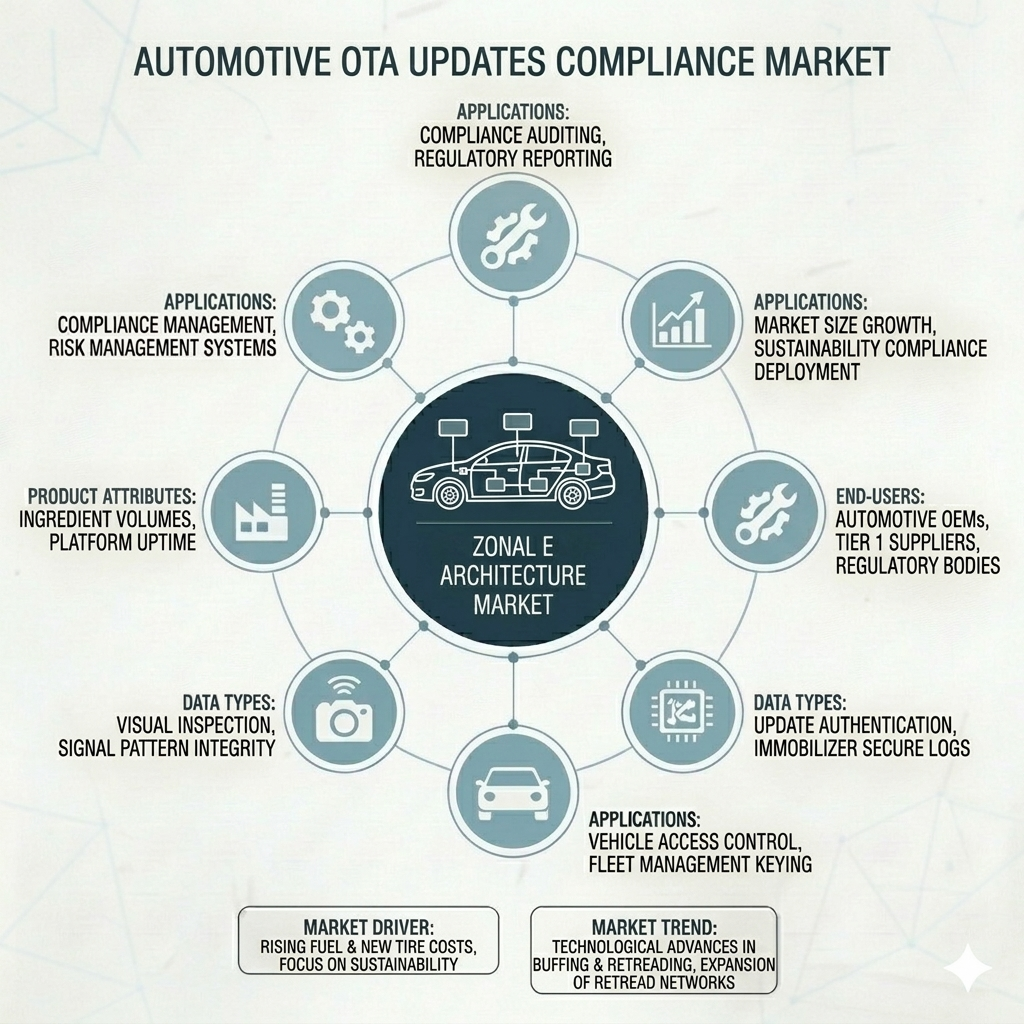
Automotive OTA Updates Compliance Market
The automotive OTA updates compliance market is projected at USD 5.41 billion in 2026 and USD 18 billion by 2036, implying a 12.75% CAGR
NEWARK, DE, UNITED STATES, March 24, 2026 /EINPresswire.com/ -- The global automotive industry has reached a definitive inflection point where software integrity is now as critical as mechanical safety. According to a landmark strategic study by Future Market Insights (FMI), the Global Automotive OTA Updates Compliance Market is valued at USD 5.41 billion in 2026 and is projected to soar to USD 18 billion by 2036, expanding at a robust compound annual growth rate (CAGR) of 12.75%.
This aggressive growth trajectory is being fueled by a "regulatory super-cycle." With global electric vehicle (EV) sales surpassing 17 million units annually, the baseline fleet requiring continuous software monitoring and cryptographic authentication has expanded beyond the capacity of legacy diagnostic tools. Procurement teams at major OEMs are rapidly pivoting toward certified Over-the-Air (OTA) lifecycle management systems to satisfy stringent UNECE WP.29 and ISO/SAE 21434 mandates.
Get Access of Report Sample:
https://www.futuremarketinsights.com/reports/sample/rep-gb-32182
The SDV Shift: From Premium Feature to Baseline Requirement
In 2026, OTA capabilities have officially transitioned from a luxury "connected car" feature to a baseline operational requirement. Volvo Cars recently signaled this shift with a massive OTA rollout covering approximately 2.5 million vehicles across 85 countries. Erik Severinson, Chief Product and Strategy Officer at Volvo Cars, emphasized that these upgrades focus on ensuring the car "gets better over time," highlighting the convergence of user experience and regulatory health.
Key Market Takeaways for 2026:
Software Dominance (70% Share): The market is overwhelmingly driven by software platforms capable of encrypted payload delivery and automated audit trails. Automakers are respecifying architectures to eliminate fragmented ECUs that complicate compliance.
Passenger Vehicle Lead (72% Share): High consumer demand for digital cockpits and Advanced Driver Assistance Systems (ADAS) has made passenger EVs the primary proving ground for secure update pipelines.
The "SOTA" Surge: Software-over-the-air (SOTA) updates hold a 60% share of the update type segment, as manufacturers prioritize agile security patching to mitigate the rising frequency of software-related recalls.
Regional Growth Dynamos: China and India Lead the Global Sprint
The adoption of OTA compliance is being dictated by regional data governance and the pace of fleet electrification. China is projected to lead the global market with a 16.0% CAGR through 2036. This growth is anchored by state-mandated data localization and supply-chain transparency rules that force automakers to integrate deep compliance monitoring into every fleet operation. India follows closely with a 15.0% CAGR, driven by domestic OEMs adopting global-platform architectures to accelerate homologation for export markets.
In the United States, the market is anticipated to expand at a 14.0% CAGR, where growth is strictly recall-driven. With the NHTSA recording recalls impacting tens of millions of vehicles, OTA capabilities have emerged as the most cost-effective path to remedy software defects while maintaining rigorous, legally defensible audit trails. Meanwhile, Europe continues to function as the technical proving ground for the industry. Germany (13.0% CAGR) and the UK (11.0% CAGR) are leading the enforcement of UNECE WP.29 regulations, requiring manufacturers to provide transparent, auditable software composition analyses (SBOM) before any vehicle can achieve type approval.
Competitive Landscape: Silicon-to-Cloud Sovereignty
The competitive arena is favoring players who can deliver fully integrated, "silicon-to-cloud" security ecosystems. Organizations with mature cryptographic infrastructure are securing multi-year platform partnerships with OEMs looking to de-risk their software-defined vehicle (SDV) rollouts.
Bosch and Continental: These Tier-1 giants are integrating high-performance computing units with native OTA provisions, effectively merging hardware and compliance software.
Qualcomm and Google: In January 2026, the two tech leaders expanded their collaboration to simplify secure Android OTA updates, focusing on reducing the complexity of multi-domain software deployments.
NXP and Infineon: Silicon providers are introducing microcontrollers specifically engineered for faster, secure OTA programming, featuring hardware-level cryptographic isolation to meet the highest safety thresholds.
Key Players in the Automotive OTA Updates Compliance Market:
• Bosch
• Continental
• Harman (Samsung)
• Aptiv
• Airbiquity
• Redbend (Harman)
• HERE Technologies
Strategic Executive Outlook: The Road to 2036
The next decade will be defined by the "Automated Audit." As the frequency of updates increases, manual compliance checks will become impossible. Industry leaders are moving toward:
1. Hardware-Level Cryptography: Implementing Hardware Security Modules (HSMs) as the only way to meet "Zero-Trust" update authentication standards.
2. Native Compliance Reporting: Integrating reporting tools directly into the OTA pipeline to generate real-time cryptographic proof of update success for global transport authorities.
3. Memory-Safe Execution: Addressing the fact that 70% of vulnerabilities stem from memory safety issues by auditing code meticulously before it enters the OTA deployment stream.
Frequently Asked Questions (FAQ)
1. What is the difference between SOTA and FOTA?
SOTA (Software-over-the-Air) typically refers to updates for infotainment, apps, and maps. FOTA (Firmware-over-the-Air) involves deeper updates to the code that controls the car's hardware, such as the powertrain, braking systems, or ADAS sensors.
2. Why is "Compliance" a separate market from "Updates"?
While many cars can receive updates, the Compliance market focuses on the security, traceability, and legal verification of those updates. Regulators require proof that an update was not tampered with, was sent by the authorized OEM, and successfully installed without compromising safety.
3. How does OTA capability reduce manufacturer costs?
Physical recalls are incredibly expensive, requiring dealership labor and owner inconvenience. A compliant OTA system allows an OEM to patch a software defect in millions of cars simultaneously from a central server, saving billions in potential recall costs and avoiding "stop-sale" orders.
4. What are UNECE WP.29 and ISO/SAE 21434?
These are the "gold standards" for automotive cybersecurity. WP.29 is a set of international regulations that make cybersecurity and secure software updates a legal requirement for vehicle approval. ISO/SAE 21434 provides the technical framework for managing those cybersecurity risks throughout a vehicle's life.
Brows More Industry Reports
Automotive Over-The-Air (OTA) Updates Market
https://www.futuremarketinsights.com/reports/automotive-over-the-air-ota-updates-market
Automotive OTA Signing, Key Management & PKI Platforms Market
https://www.futuremarketinsights.com/reports/automotive-ota-signing-key-management-and-pki-platforms-market
Automotive OTA Cybersecurity Stress Test Equipment Market
https://www.futuremarketinsights.com/reports/automotive-ota-cybersecurity-stress-test-equipment-market
Sudip Saha
Future Market Insights Inc.
+1 347-918-3531
email us here
Legal Disclaimer:
EIN Presswire provides this news content "as is" without warranty of any kind. We do not accept any responsibility or liability for the accuracy, content, images, videos, licenses, completeness, legality, or reliability of the information contained in this article. If you have any complaints or copyright issues related to this article, kindly contact the author above.
