

Global DMPA Market Growth to USD 561.8 Million by 2036 at 6.3% CAGR Led by Eco-Friendly Coatings
Growing adoption of eco-friendly adhesives and coatings is accelerating expansion of the dimethylolpropionic acid market globally
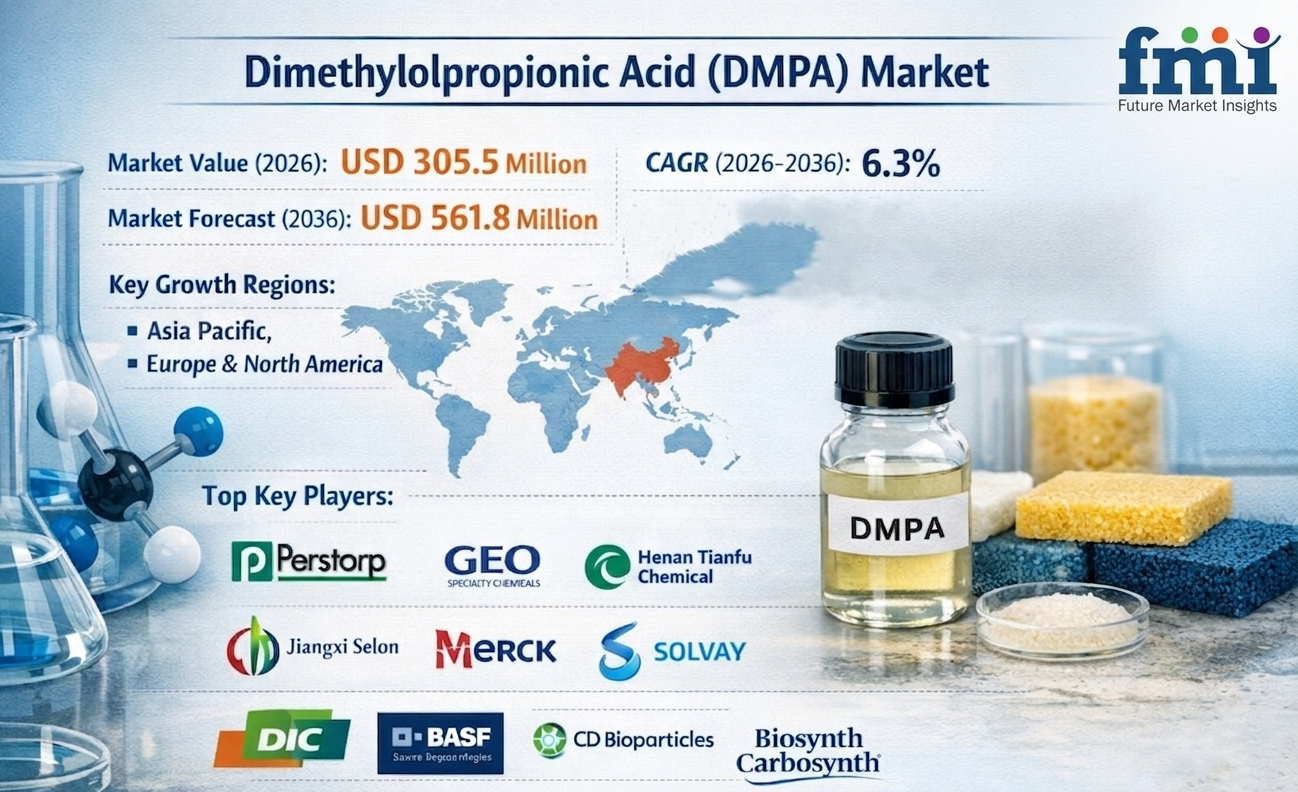
NEWARK, DE, UNITED STATES, March 27, 2026 /EINPresswire.com/ -- The global Dimethylolpropionic Acid (DMPA) market is valued at USD 305.5 million in 2026 and is projected to reach USD 561.8 million by 2036, expanding at a CAGR of 6.3% during the forecast period. Growth is primarily driven by increasing adoption of waterborne polyurethane dispersions (PUDs), stringent environmental regulations, and rising demand for sustainable coatings and adhesives across key industries.
As industries transition toward environmentally responsible manufacturing, DMPA is emerging as a critical component in waterborne systems. Its role in enabling low-VOC, high-performance polyurethane formulations positions it as a strategic material in coatings, adhesives, and specialty applications.
Dimethylolpropionic Acid (DMPA) Market Snapshot (2026–2036)
• Market size in 2026: USD 305.5 million
• Market size in 2036: USD 561.8 million
• CAGR (2026–2036): ~6.3%
• Leading application: Polyurethane Dispersion (PUD)
• Top end-use segment: Coatings & adhesives
• Dominant product grade: Standard (industrial) DMPA
• Fastest-growing country: India
• Key companies: Global specialty chemical manufacturers and regional producers
Market Momentum
The DMPA market begins at USD 305.5 million in 2026, supported by strong demand for waterborne polyurethane systems in coatings and adhesives. Between 2027 and 2030, increasing regulatory pressure on VOC emissions accelerates the shift from solvent-based to waterborne technologies.
Entering 2032 and beyond, advancements in high-purity DMPA grades, integration with PUD manufacturing, and growing demand from automotive and electronics sectors further strengthen market expansion. By 2036, the market reaches USD 561.8 million, driven by widespread adoption across coatings, packaging, textiles, and construction applications.
Request For Sample Report | Customize Report |purchase Full Report - https://www.futuremarketinsights.com/reports/sample/rep-gb-339
Why the Market is Growing
The DMPA market is expanding as industries prioritize sustainable and low-emission chemical solutions. DMPA plays a crucial role in producing waterborne polyurethane dispersions that deliver high performance while meeting environmental compliance standards.
Its ability to enhance dispersion stability, durability, and adhesion properties makes it essential in coatings, adhesives, and synthetic leather applications. Increasing demand for eco-friendly packaging, automotive coatings, and construction materials further accelerates adoption.
Additionally, the global push toward green chemistry and carbon footprint reduction is encouraging manufacturers to develop bio-based and mass-balance DMPA solutions, strengthening long-term market growth.
Segment Spotlight
1. Application: Polyurethane Dispersion (PUD) Leads
PUD accounts for approximately 34% of the market, driven by strong demand for waterborne coatings and adhesives in automotive, furniture, and textile industries.
2. Product Grade: Standard DMPA Dominates
Standard (industrial) DMPA holds around 48% share, owing to its cost-effectiveness and widespread use in general-purpose coatings, adhesives, and finishes.
3. End Use: Coatings & Adhesives Lead Demand
Coatings and adhesives remain the primary end-use segments, supported by increasing need for durable, low-VOC, and high-performance materials.
Drivers, Opportunities, Trends, Challenges
Drivers
• Stringent VOC emission regulations
• Growing demand for waterborne coatings and adhesives
• Expansion of automotive and construction industries
Opportunities
• Bio-based and sustainable DMPA development
• Growth in electric vehicle coatings
• Increasing demand for eco-friendly packaging
Trends
• Shift toward high-purity and ultra-low color DMPA
• Integration with backward PUD manufacturing
• Adoption of mass-balance certified products
Challenges
• Raw material price volatility
• Performance limitations vs solvent-based systems
• Competition from alternative ionic monomers
Country Growth Outlook (2026–2036)
• India: 7.3% CAGR (fastest growth driven by manufacturing expansion)
• China: 6.9% CAGR (strong industrial and construction demand)
• Brazil: 6.5% CAGR (growing packaging and furniture sectors)
• Germany: 6.3% CAGR (focus on sustainable coatings)
• South Korea: 6.2% CAGR (electronics and automotive demand)
Competitive Landscape
The DMPA market is moderately consolidated, with competition centered on product purity, performance, and technical support. Key players are investing in R&D, high-purity grades, and sustainable production technologies to strengthen their market position.
Strategic focus areas include:
• Development of eco-friendly and bio-based DMPA
• Expansion of production capacities in Asia
• Integration with polyurethane dispersion manufacturing
• Enhancing supply chain efficiency and quality control
Regional manufacturers, particularly in Asia, are gaining traction due to cost advantages and strong domestic demand, while global players focus on innovation and specialty applications.
Key Players: Perstorp Specialty Chemicals AB, GEO Specialty Chemicals, Inc., Henan Tianfu Chemical Co., Ltd., Jiangxi Selon Industrial Co., Ltd., Merck (Sigma-Aldrich), Solvay S.A., DIC Corporation, BASF SE, CD Bioparticles
Frequently Asked Questions (FAQ)
What is the global DMPA market size?
The market is valued at USD 305.5 million in 2026 and is projected to reach USD 561.8 million by 2036.
At what rate is the market expected to grow?
The market is forecast to grow at a CAGR of approximately 6.3% from 2026 to 2036.
What is Dimethylolpropionic Acid (DMPA)?
DMPA is a chemical compound used in producing waterborne polyurethane dispersions, widely applied in coatings, adhesives, and elastomers.
Why is DMPA gaining importance?
It enables low-VOC, eco-friendly, and high-performance polyurethane systems, aligning with global sustainability and regulatory requirements.
Explore More Related Studies Published by FMI Research:
Lithium and Lithium Ion Battery Electrolyte Market: https://www.futuremarketinsights.com/reports/lithium-and-lithium-ion-battery-electrolytes-market
Fiberglass Market: https://www.futuremarketinsights.com/reports/fiberglass-market
Magnesium Carbonate Market: https://www.futuremarketinsights.com/reports/magnesium-carbonate-market
About Future Market Insights (FMI)
Future Market Insights, Inc. (FMI) is an ESOMAR-certified, ISO 9001:2015 market research and consulting organization, trusted by Fortune 500 clients and global enterprises. With operations in the U.S., UK, India, and Dubai, FMI provides data-backed insights and strategic intelligence across 30+ industries and 1200 markets worldwide.
Why Choose FMI: https://www.futuremarketinsights.com/why-fmi
Sudip Saha
Future Market Insights Inc.
+ +1 347-918-3531
rahul.singh@futuremarketinsights.com
Legal Disclaimer:
EIN Presswire provides this news content "as is" without warranty of any kind. We do not accept any responsibility or liability for the accuracy, content, images, videos, licenses, completeness, legality, or reliability of the information contained in this article. If you have any complaints or copyright issues related to this article, kindly contact the author above.
