

Global Pump and Dispenser Market to Reach USD 84.6 Billion by 2036 Led by North America and AptarGroup Inc. Innovation
Pump and Dispenser Market
The USA market is growing at a 6.9% CAGR, driven by personal care, pharma demand, e-commerce growth, and innovation in premium, durable dispensing packaging
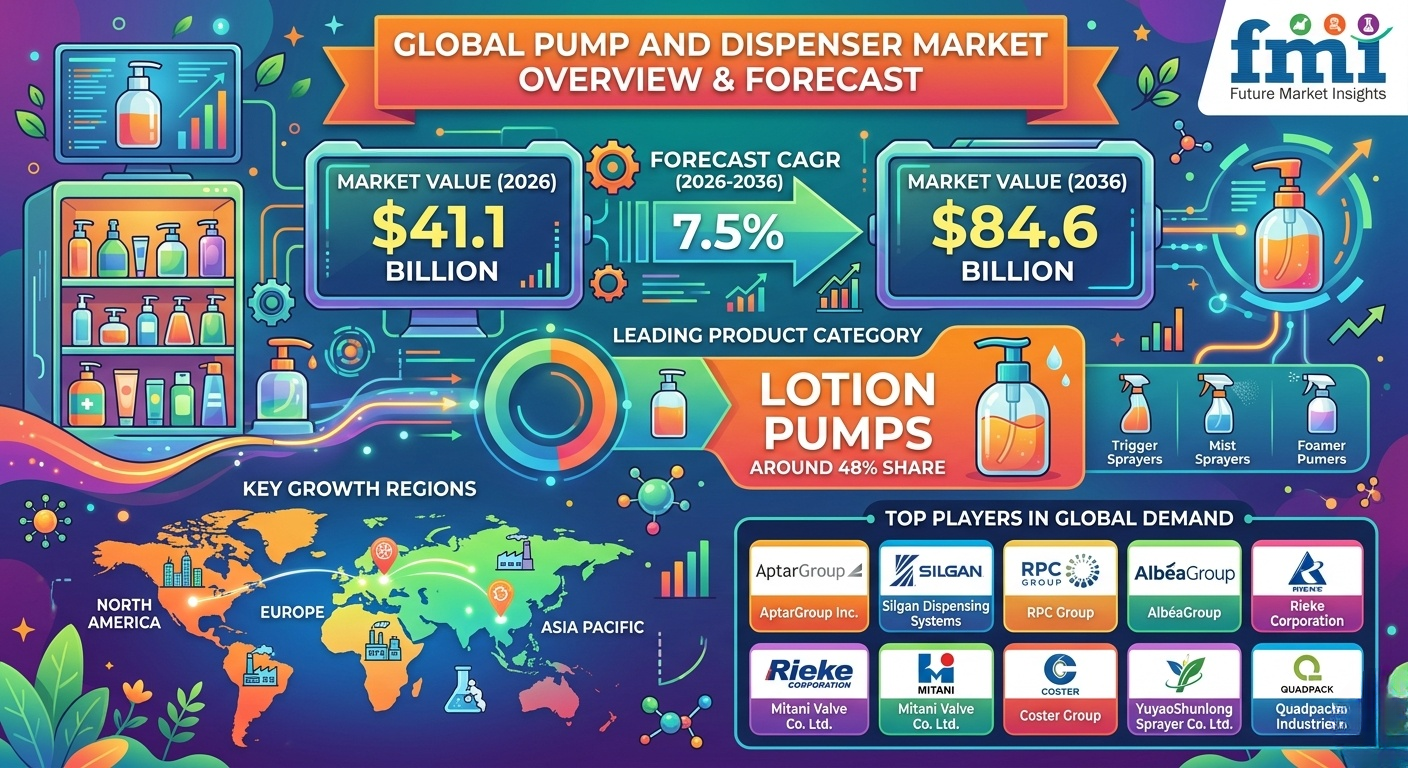
NEWARK, DE, UNITED STATES, March 27, 2026 /EINPresswire.com/ -- The global pump and dispenser market is entering a new phase of packaging innovation and functional design transformation, driven by rising demand across personal care, pharmaceuticals, food packaging, and household products. Valued at USD 41.1 billion in 2026, the market is projected to reach USD 84.6 billion by 2036, expanding at a CAGR of 7.5% over the forecast period. The growth trajectory reflects the increasing importance of controlled dispensing, hygiene-focused packaging, and premium product presentation across consumer and industrial markets worldwide.
According to a comprehensive strategic outlook from Future Market Insights (FMI), pumps and dispensers are no longer viewed as simple packaging components but as critical functional packaging systems that influence product usability, brand positioning, and consumer experience.
Discover Growth Opportunities in the Market – Get Your Sample Report Now
https://www.futuremarketinsights.com/reports/sample/rep-gb-6663
The Functional Packaging Shift: From Closure Component to User Experience Technology
The pump and dispenser industry is undergoing a structural shift as packaging evolves from basic containment solutions to user experience-driven delivery systems. Modern pumps and dispensers are engineered to deliver precise dosing, reduce contamination risks, improve product shelf life, and enhance consumer convenience.
Manufacturers are increasingly focusing on mechanism reliability, compatibility with different product viscosities, and design aesthetics that help brands differentiate products on retail shelves and online marketplaces. Airless dispensing systems, foam pumps, and precision dosing pumps are becoming key innovation areas, particularly in premium skincare, pharmaceuticals, and specialty food products.
Industry analysts note that packaging decisions are increasingly influenced by user convenience, hygiene standards, and sustainability goals rather than just cost considerations. This shift is transforming pumps and dispensers into strategic packaging components rather than commodity accessories.
Sustainability and Material Innovation Reshaping Production Strategies
One of the most significant structural changes in the pump and dispenser market is the growing pressure to reduce plastic usage and improve recyclability. Governments, brands, and consumers are pushing packaging manufacturers to develop environmentally responsible dispensing solutions.
Manufacturers are responding through:
• Lightweight pump designs
• Recyclable mono-material components
• Refillable packaging systems
• PCR-compatible plastic components
• Reduced packaging waste designs
These sustainability initiatives are increasing research and development investments and influencing material selection across the industry. Companies that can successfully balance durability, cost efficiency, recyclability, and performance are expected to gain competitive advantage over the next decade.
E-Commerce and Hygiene Trends Driving Dispensing System Adoption
The rapid expansion of e-commerce and direct-to-consumer distribution channels is significantly influencing pump and dispenser design requirements. Products sold online require leak-resistant, durable, and transport-safe dispensing systems that can withstand shipping and handling without damage or leakage.
At the same time, rising hygiene awareness across personal care, cosmetics, pharmaceuticals, and household cleaning products is accelerating pump and dispenser adoption. Dispensing systems help reduce direct product contact, minimize contamination risks, and ensure consistent dosage delivery, making them essential for hygiene-sensitive products.
As a result, pumps and dispensers are increasingly used across:
• Skincare and cosmetics
• Haircare products
• Liquid soaps and sanitizers
• Pharmaceutical syrups and liquids
• Food sauces and condiments
• Household cleaning liquids
This broad application base is supporting stable long-term market growth.
Segment Spotlight: Lotion Pumps and Personal Care Applications Lead Demand
Lotion Pumps: The Dominant Product Category
Lotion pumps account for approximately 48% of global demand, making them the largest product segment in the pump and dispenser market. Their widespread adoption is driven by their ability to handle multiple viscosity levels and their consistent dosing performance.
Lotion pumps are commonly used in:
• Skincare products
• Haircare products
• Body lotions
• Liquid soaps
• Household cleaning products
Their simple design, cost efficiency, reliability, and compatibility with standardized bottle formats make them the preferred dispensing solution for both packaging manufacturers and consumer product brands.
Personal Care and Cosmetics: Largest End-Use Segment
Personal care and cosmetics represent approximately 44% of global demand, making it the largest end-use application for pumps and dispensers. The segment benefits from increasing global consumption of beauty and skincare products, premium packaging trends, and rising hygiene awareness.
Innovations such as airless pumps, customized actuator designs, and premium dispensing formats are helping brands improve product differentiation and enhance consumer experience, further supporting demand growth in this segment.
Regional Growth Outlook: Asia and North America Drive Market Expansion
While the pump and dispenser market is global in nature, growth patterns vary across regions based on manufacturing capabilities, consumer product demand, and packaging innovation trends.
• China (9.2% CAGR): China represents the fastest-growing market due to its large-scale manufacturing ecosystem, expanding personal care industry, and strong packaging production capabilities. The country’s role as both a manufacturing hub and a major consumer market supports rapid growth.
• United States (6.9% CAGR): The U.S. market is driven by strong demand for premium personal care packaging, pharmaceutical dispensing solutions, and e-commerce-ready packaging formats.
• Germany (6.5% CAGR): Germany’s growth is supported by its advanced packaging manufacturing industry and strong focus on engineering precision and packaging quality.
• United Kingdom (6.2% CAGR): Growth is driven by premium beauty markets and strong retail packaging differentiation strategies.
• Japan (5.8% CAGR): Japan maintains steady growth due to its emphasis on product precision, reliability, and high-quality packaging systems.
Overall, Asia Pacific, North America, and Europe remain the key demand centers for pumps and dispensers globally.
Dynamics of the Decade: Precision Dispensing, Airless Packaging, and Sustainability
Looking toward 2036, several long-term trends are expected to reshape the pump and dispenser industry:
• Precision Dispensing Systems: Increasing demand for controlled dosing in pharmaceuticals, cosmetics, and food products will drive innovation in dispensing mechanisms.
• Airless Packaging Growth: Airless pump systems that protect sensitive formulations from air exposure are expected to see strong growth in premium skincare and pharmaceutical packaging.
• Refillable and Reusable Packaging: Sustainability regulations and consumer preferences will push brands toward refill-based packaging systems.
• Mono-Material Packaging: To improve recyclability, manufacturers are developing pumps made from single-material components.
• E-Commerce Optimized Packaging: Lock-down mechanisms and leak-proof pump designs will become standard for products sold online.
Competitive Landscape: Innovation, Reliability, and Sustainability Define Market Leadership
The pump and dispenser market shows moderate competitive concentration, with competition driven more by mechanism reliability, dosing accuracy, sustainability compliance, and formulation compatibility than price alone.
Leading global companies such as
• AptarGroup Inc.,
• Silgan Dispensing Systems
• RPC Group
hold strong market positions due to their global manufacturing networks, proprietary dispensing technologies, and long-term partnerships with multinational personal care and pharmaceutical companies.
Other important players including
• Albéa Group,
• Rieke Corporation,
• Coster Group,
• Mitani Valve Co. Ltd.
• Quadpack Industries
are strengthening their presence through customization capabilities, premium packaging solutions, and regional manufacturing advantages.
Asian manufacturers are also becoming increasingly competitive due to cost efficiency, automation upgrades, and proximity to major personal care manufacturing hubs.
Industry competition is gradually shifting toward value-driven differentiation, where technical expertise, sustainability alignment, product reliability, and long-term customer relationships define market leadership.
Why FMI: https://www.futuremarketinsights.com/why-fmi
Explore More Research Reports by FMI
Paper Core Market - https://www.futuremarketinsights.com/reports/paper-cores-market
Linerless Label Market - https://www.futuremarketinsights.com/reports/linerless-labels-market
Tube and Core Market - https://www.futuremarketinsights.com/reports/tubes-and-cores-market
Smart Labeling & Consumer Transparency Systems for PCR Content Market - https://www.futuremarketinsights.com/reports/smart-labeling-consumer-transparency-systems-for-pcr-content-market
About Future Market Insights (FMI)
Future Market Insights, Inc. (FMI) is an ESOMAR-certified, ISO 9001:2015 market research and consulting organization, trusted by Fortune 500 clients and global enterprises. With operations in the U.S., UK, India, and Dubai, FMI provides data-backed insights and strategic intelligence across 30+ industries and 1200 markets worldwide.
Sudip Saha
Future Market Insights Inc.
+1 347-918-3531
email us here
Legal Disclaimer:
EIN Presswire provides this news content "as is" without warranty of any kind. We do not accept any responsibility or liability for the accuracy, content, images, videos, licenses, completeness, legality, or reliability of the information contained in this article. If you have any complaints or copyright issues related to this article, kindly contact the author above.
