

Future of the Hexyl Acetate Market: Price Trends, Capacity Expansion and Global Demand (2026–2036)
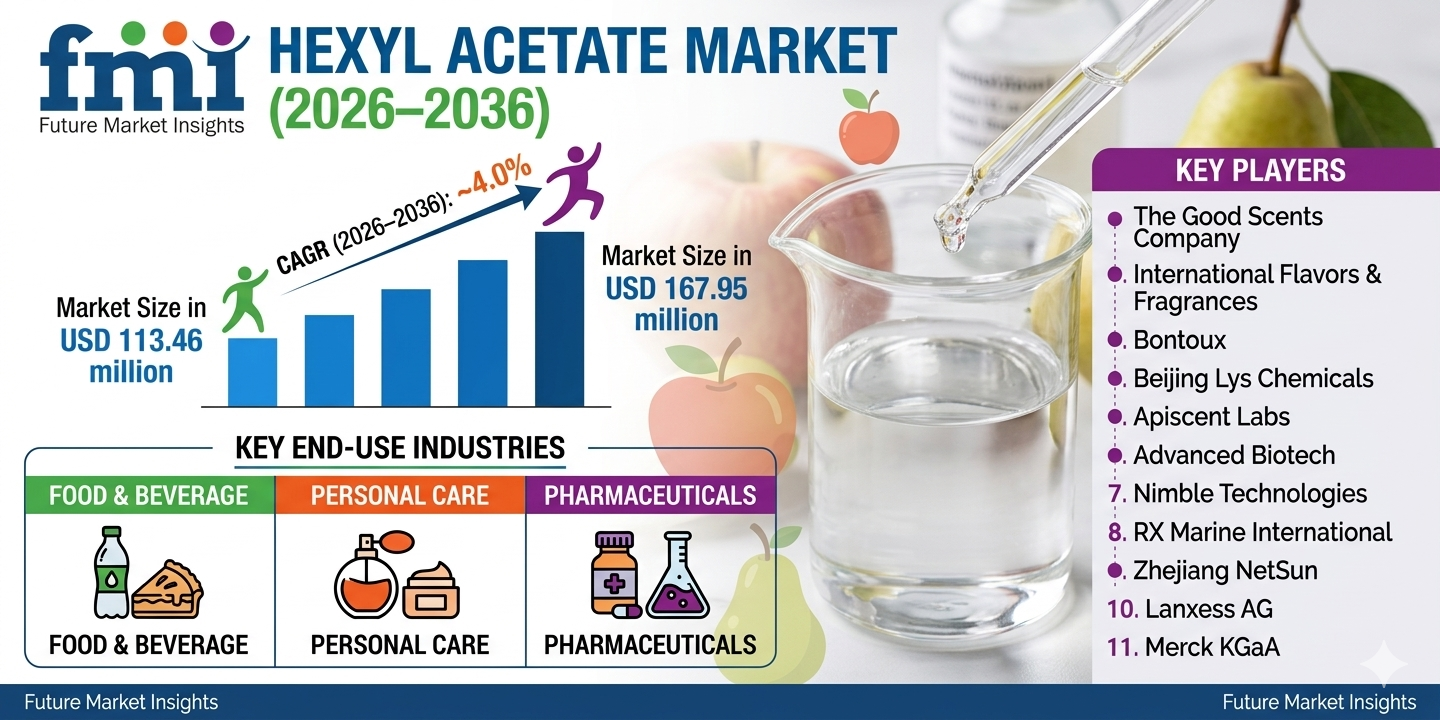
Rising demand for clean-label flavor ingredients and fragrance applications drives steady market expansion
NEWARK, DE, UNITED STATES, March 31, 2026 /EINPresswire.com/ -- The global hexyl acetate market is valued at USD 113.46 million in 2026 and is projected to reach USD 167.95 million by 2036, expanding at a CAGR of 4.0% during the forecast period. Growth is primarily driven by increasing demand for natural and clean-label flavoring ingredients in food and beverage formulations, along with expanding applications in fragrance compounding and specialty solvents.
As consumer preferences shift toward naturally derived and sensory-enhanced products, hexyl acetate is transitioning from a conventional ester ingredient into a strategically positioned compound across flavor, fragrance, and industrial value chains.
Hexyl Acetate Market Snapshot (2026–2036)
• Market size in 2026: USD 113.46 million
• Market size in 2036: USD 167.95 million
• CAGR (2026–2036): ~4.0%
• Leading synthesis type: Catalyzed reactive distillation
• Top application segment: Flavoring agent
• Fastest-growing country: China
• Key end-use industries: Food & beverage, personal care, pharmaceuticals
Market Momentum
The hexyl acetate market begins at USD 113.46 million in 2026, supported by stable demand across flavor and fragrance applications. Between 2027 and 2030, growth is reinforced by increasing adoption of natural flavoring ingredients and regulatory alignment favoring low-toxicity compounds.
From 2031 onward, advancements in enzymatic synthesis and growing investments in clean-label production technologies further accelerate market penetration. By 2036, the market reaches USD 167.95 million, maintaining consistent growth as hexyl acetate becomes an essential ingredient in multi-industry formulations.
Why the Market is Growing
The hexyl acetate market is expanding as manufacturers respond to evolving consumer demand for natural, safe, and aromatic ingredients. In the food and beverage sector, hexyl acetate is widely used to impart fruity apple and pear flavor profiles, aligning with the clean-label movement and regulatory standards in major markets.
Fragrance applications provide a secondary growth channel, where the compound is valued for its ability to deliver fresh, fruity top notes in perfumes, personal care products, and home fragrances. Additionally, pharmaceutical and industrial applications contribute to steady demand due to its effectiveness as a specialty solvent.
Rather than being limited to a single function, hexyl acetate is increasingly evaluated as a multifunctional ingredient capable of delivering sensory, functional, and regulatory benefits across diverse applications.
Segment Spotlight
1. Application: Flavoring Agent Leads Demand
The flavoring agent segment accounts for approximately 42.3% of total demand in 2026. Its dominance is driven by extensive use in confectionery, beverages, and dairy products, where fruity flavor profiles remain consistently popular.
2. Type: Catalyzed Reactive Distillation Dominates
Catalyzed reactive distillation holds a 57.9% share, reflecting its cost-efficiency and scalability for industrial production. This method remains the preferred choice for large-scale manufacturing despite the growing adoption of enzymatic synthesis.
3. Emerging Trend: Enzymatic Synthesis Gains Traction
Lipase-catalyzed ester synthesis is gaining importance as it enables natural classification under regulatory frameworks, allowing manufacturers to capture premium clean-label segments.
Drivers, Opportunities, Trends, Challenges
Drivers:
• Rising demand for clean-label and natural flavor ingredients
• Growth in fragrance and personal care applications
• Expanding use in food, beverage, and household products
Opportunities:
• Enzymatic synthesis for natural-grade production
• Premium pricing for naturally derived esters
• Expansion in emerging markets
Trends:
• Shift toward bio-based and sustainable ingredients
• Increased use in multi-sensory product development
• Strategic partnerships between suppliers and fragrance houses
Challenges:
• Cost differences between synthetic and natural production
• Regulatory compliance across regions
• Raw material and production efficiency constraints
Country Growth Outlook (2026–2036)
China leads global growth with a CAGR of 5.4%, driven by large-scale fragrance manufacturing and expanding personal care production. India follows at 5.0%, supported by rising consumption in processed foods and cosmetics. Germany and France maintain steady growth due to strong che
mical and fragrance industries, while mature markets such as the United States and the United Kingdom show moderate but stable expansion.
Competitive Landscape
The hexyl acetate market features a mix of global flavor and fragrance companies, specialty chemical manufacturers, and regional suppliers competing on product quality, regulatory compliance, and cost efficiency.
Key players are focusing on expanding production capacity, developing natural-grade variants, and strengthening partnerships with downstream industries. Emphasis is increasingly placed on purity standards, consistent aroma profiles, and sustainable sourcing practices to meet evolving market expectations.
Strategic initiatives such as technological innovation, supply chain optimization, and digital distribution channels are shaping the competitive environment, enabling companies to strengthen their presence across both mature and emerging markets.
Frequently Asked Questions (FAQ)
What is the global hexyl acetate market size?
The market is valued at approximately USD 113.46 million in 2026 and is projected to reach USD 167.95 million by 2036.
What is the expected growth rate?
The market is expected to grow at a CAGR of about 4.0% from 2026 to 2036.
What is hexyl acetate used for?
Hexyl acetate is used as a flavoring agent in food and beverages, a fragrance component in personal care products, and a solvent in pharmaceutical and industrial applications.
Why is hexyl acetate gaining import
ance?
It supports clean-label formulation trends, enhances sensory appeal in products, and offers versatility across multiple industries while meeting regulatory safety standards.
Explore More Related Studies Published by FMI Research:
High Thermal Stability Separator Polymers for Fast Charging Batteries Market https://www.futuremarketinsights.com/reports/high-thermal-stability-separator-polymers-for-fast-charging-batteries-market
High Performance Separator Polymer Systems for Global Cell Makers Market https://www.futuremarketinsights.com/reports/high-performance-separator-polymer-systems-for-global-cell-makers-market
Fermentation-Engineered Monomers for Compostable Film and Rigid Packaging Market https://www.futuremarketinsights.com/reports/fermentation-engineered-monomers-for-compostable-film-and-rigid-packaging-market
About Future Market Insights (FMI)
Fture Market Insights, Inc. (FMI) is an ESOMAR-certified, ISO 9001:2015 market research and consulting organization, trusted by Fortune 500 clients and global enterprises. With operations in the U.S., UK, India, and Dubai, FMI provides data-backed insights and strategic intelligence across 30+ industries and 1200 markets worldwide.
Why Choose FMI: https://www.futuremarketinsights.com/why-fmi
Sudip Saha
Future Market Insights Inc.
+1 347-918-3531
rahul.singh@futuremarketinsights.com
Legal Disclaimer:
EIN Presswire provides this news content "as is" without warranty of any kind. We do not accept any responsibility or liability for the accuracy, content, images, videos, licenses, completeness, legality, or reliability of the information contained in this article. If you have any complaints or copyright issues related to this article, kindly contact the author above.
