

New Remesh Research: 43% of Employees Say They Have No Voice in Their Organization's AI Rollout

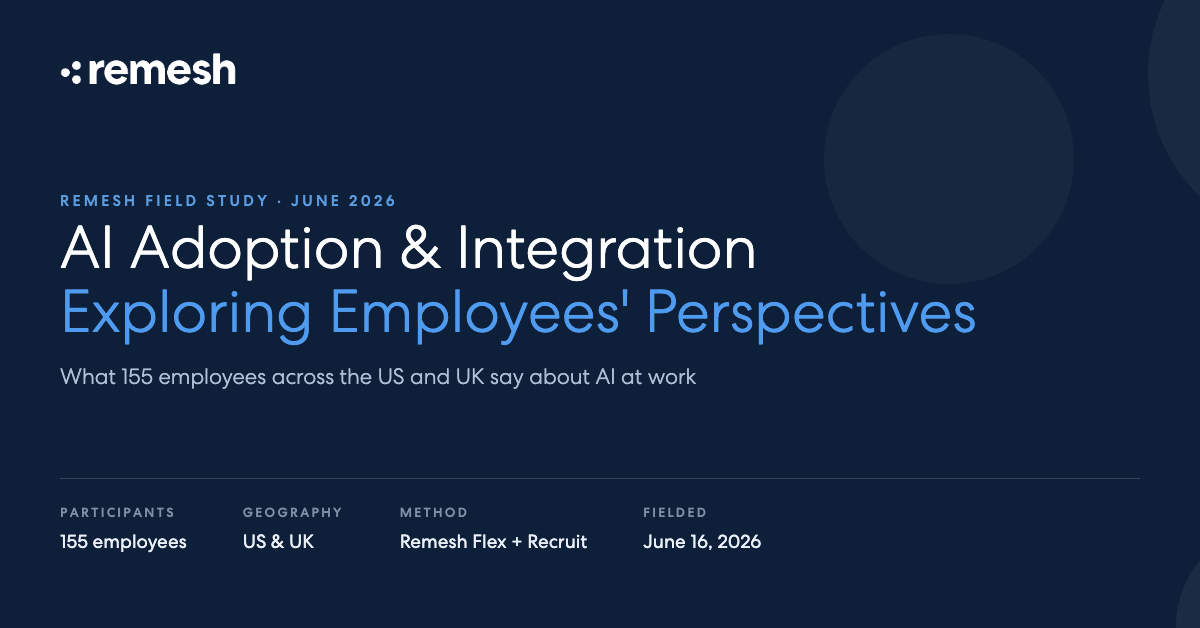
June 2026 Remesh Field Study
An original study of 155 employees finds that AI adoption succeeds or stalls based on whether workers are consulted, not how much tech their employer buys.
The organization should create a feedback loop where employees can share successes and challenges arising from day to day AI use to allow continuous improvement.”
NEW YORK, NY, UNITED STATES, August 19, 2026 /EINPresswire.com/ -- Employees Are Being Informed About AI, Not Consulted— Study participant, Remesh employee field study, June 2026.
Organizations are moving quickly on AI. Most are not bringing their workforces with them.
In a new field study conducted on the Remesh platform, 43% of employees said they are either not involved at all in AI integration efforts in their area of work (13%) or informed about decisions but never consulted on them (30%). Another 31% said they are consulted only occasionally. Just 26% reported being regularly involved in discussions and decisions or actively helping shape implementation.
The finding lands against a backdrop of steady, if shallow, adoption. Three quarters of employees said their organization's AI integration has been at least moderately effective, and 66% described its impact on culture and team dynamics as positive. But depth of use remains limited: only 10% use AI for most of their work tasks, while 46% use it for less than a quarter of their tasks or not at all.
Leaders Think They Have Communicated. Employees Disagree.
The study follows Remesh research published earlier this year, in which 105 supervisors, managers, and senior leaders assessed AI governance at their own organizations. Asked the same question two months apart, the two groups gave sharply different answers.
44% of leaders said their organization provides clear, well-communicated AI guidance. Only 22% of employees said the same. Employees were also more likely to report operating with informal norms or with very limited guidance of any kind.
Guidance that leaders consider clear is not registering as clear with employees.
Participation Predicts Nearly Everything Else
Employees who help shape AI integration report a fundamentally different experience of it than employees who are simply told about it. Comparing the two groups within the same study:
- Autonomy and dignity: roughly 40% of employees involved in shaping AI said it primarily increases employee autonomy and dignity at work. Among employees informed but not consulted, about 3% said the same.
- Culture: 47% of involved employees described AI's cultural impact as very positive, compared with 11% of those without a voice in the process.
- Guidance: 45% of involved employees reported clear, well-communicated AI guidance, compared with 9% of those informed but not consulted.
- Usage: among employees not involved at all, 37% said they rarely or never use AI, and 21% said they do not have access to AI tools for work.
Notably, employees did not name participation as their top request. Asked to rank ten common AI integration strategies, they placed "involve employees in the AI integration process" fifth. While participation isn’t something that employees demanded, according to this study it correlates heavily with whether they found AI helpful at their organization.
What Employees Actually Asked For
The ranking exercise produced a clear and somewhat counterintuitive hierarchy. Employees ranked training and skill development first, communicating a clear AI strategy and vision second, and establishing policies for responsible AI use third.
They ranked "increase leadership support and sponsorship" last of the ten strategies. Investing in better AI tools and technology finished seventh.
The message is consistent across the open-ended responses, where participants asked repeatedly for hands-on training, role-specific examples, step by step tutorials, and clear boundaries on when AI should and should not be used. One participant, in a response endorsed by 82% of the group, asked their employer to "offer us more training and resources instead of leaving us to figure this stuff out for ourselves."
Employees are not asking for more executive enthusiasm about AI. They are asking to be equipped for it, and to be asked about it.
About the Research
The study was conducted in June 2026 using Remesh Flex + Recruit. 155 employees from a range of industries answered a combination of open and closed-ended questions in a human-moderated conversation, with Remesh's AI and natural language processing analyzing responses in real time. Participants also endorsed or rejected one another's open-text responses, allowing collective agreement to surface at scale. Remesh Autocode categorized qualitative themes.
The sample was 49% female and 51% male; 29% Gen Z, 54% Millennial, 15% Gen X, and 3% Baby Boomer. Participants worked in Hospitals and Healthcare (19%), Technology (12%), Manufacturing (10%), Financial Services (8%), Professional Services (8%), and other sectors. 54% were based in the United Kingdom and 46% in the United States.
Comparison figures for leaders are drawn from a companion Remesh field study of 105 supervisors, managers, and senior leaders conducted in May 2026. Results from both studies are directional rather than generalizable, and subgroup findings reflect smaller cell sizes within each sample.
The full report is available at https://hello.remesh.ai/impact-ai-org-culture-report
About Remesh
Remesh is the AI-powered research platform that helps organizations understand their customers and employees at scale. Unlike traditional surveys and focus groups, Remesh enables live, human-moderated conversations with large groups simultaneously, with AI and natural language processing analyzing responses in the background to surface nuanced human insight that closes the gap between what organizations assume and what people actually think and feel.
Remesh original research is produced directly on the platform, making the methodology itself a demonstration of what organizations can do when they choose to listen at scale.
Learn more by requesting a demo.
Emma Borochoff
Remesh
hello@remesh.ai
Visit us on social media:
LinkedIn
Legal Disclaimer:
EIN Presswire provides this news content "as is" without warranty of any kind. We do not accept any responsibility or liability for the accuracy, content, images, videos, licenses, completeness, legality, or reliability of the information contained in this article. If you have any complaints or copyright issues related to this article, kindly contact the author above.
