

Food Antioxidants Market Set to Reach USD 3.91 Billion by 2035 as Natural Ingredients Gain Momentum
Food Antioxidants Market
Food Antioxidants Market is expanding as demand rises for clean-label preservation, longer shelf life & natural antioxidant ingredients across food and beverage
Rising demand for clean-label and natural preservation solutions is driving innovation and creating new opportunities in the food antioxidants market.”
NEW YORK, NY, UNITED STATES, August 30, 2026 /EINPresswire.com/ -- Global Food Antioxidants Market Overview— Market Research Future (MRFR)
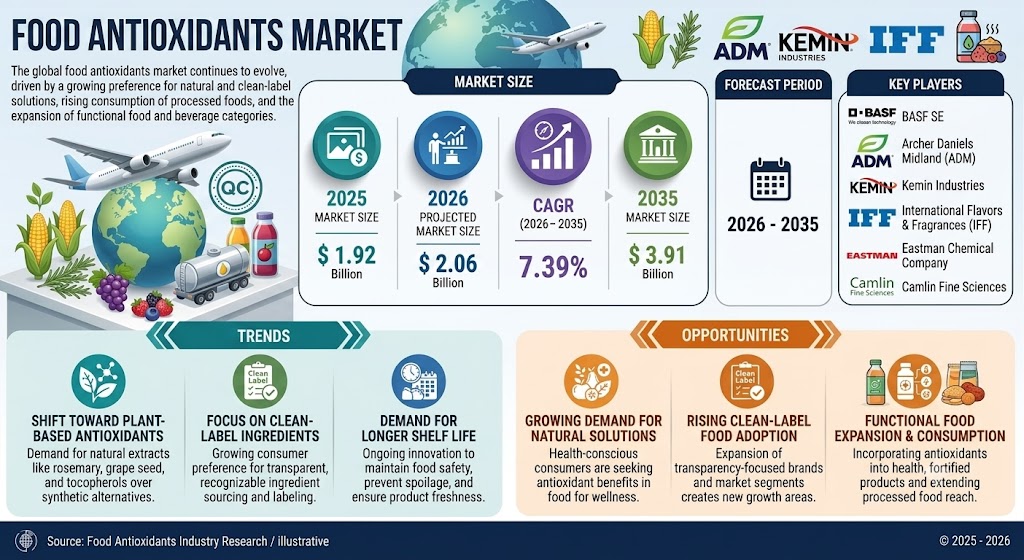
The global Food Antioxidants Market is entering a period of sustained expansion as food manufacturers respond to increasing demand for freshness, product stability, clean-label formulations, and ingredient functionality. Antioxidants play an important role in protecting food products from oxidation, helping preserve sensory characteristics, quality, and shelf life across a broad range of applications. According to the supplied market outlook, the global food antioxidants industry is valued at USD 1.92 billion in 2025 and is expected to reach USD 3.91 billion by 2035, advancing at a 7.39% CAGR between 2026 and 2035.
The market encompasses antioxidant ingredients used across natural and synthetic categories, multiple source materials, different ingredient forms, and diverse food applications. The industry is being influenced by changing consumer expectations, evolving food-processing practices, increased attention to ingredient transparency, and manufacturers' need to maintain food quality throughout increasingly complex distribution networks.
Market Valuation Reflects Strong Industry Potential:
The global food antioxidants industry is projected to move from USD 1.92 billion in 2025 to USD 2.06 billion in 2026, before reaching approximately USD 3.91 billion in 2035. The progression reflects expanding utilization of antioxidant ingredients across food categories and the industry's ongoing shift toward solutions that combine preservation performance with consumer-oriented ingredient profiles.
The projected 7.39% CAGR during 2026–2035 indicates that demand is not being generated by a single application or geographic market. Instead, expansion is supported by several interconnected developments, including growing consumption of packaged and processed foods, greater interest in functional ingredients, rising demand for naturally sourced ingredients, and continued technological improvements in extraction and formulation.
Food manufacturers are increasingly evaluating antioxidants not only as preservation tools but also as part of broader product-development strategies. Natural extracts, plant-derived compounds, and antioxidant-rich sources can support positioning around recognizable ingredients and wellness-oriented formulations. At the same time, synthetic antioxidants continue to serve applications where consistency, stability, technical performance, and cost considerations remain important.
Natural Antioxidants Gain Strategic Importance:
One of the most influential developments in the food antioxidants industry is the growing attention given to natural sources. Consumers are increasingly interested in food products containing recognizable ingredients and formulations perceived as closer to natural food profiles. This preference is encouraging food companies to explore antioxidant ingredients derived from fruits, vegetables, herbs, spices, nuts, seeds, and other botanical materials.
Natural antioxidants can provide manufacturers with opportunities to respond to clean-label expectations while supporting product stability. Their growing use is also connected with the broader development of plant-based foods, functional foods, premium snacks, beverages, and wellness-oriented products.
For ingredient suppliers, this trend creates an opportunity to develop differentiated extracts with consistent performance, strong sensory compatibility, and reliable sourcing. Companies capable of combining extraction expertise with food-application knowledge can potentially strengthen their position as manufacturers seek alternatives that fit evolving formulation requirements.
Get Full PDF Sample Copy of Report: (Including Full TOC, List of Tables & Figures, Chart) @
https://www.marketresearchfuture.com/sample_request/4534
Food Antioxidants Market Segmentation:
By Type:
▪️Natural: 9.7% CAGR (2026–2035), driven by clean-label demand.
▪️Synthetic: 56.1% share (2025), supported by cost efficiency.
By Source:
▪️Plant Extracts: USD 0.80 billion (2025), led by rosemary and green tea.
▪️Algae-Based: 10.7% CAGR, driven by carotenoids and astaxanthin.
▪️Chemically Synthesized: 37.2% share, supported by established approvals.
▪️Others: USD 0.28 billion, including fermentation-based actives.
By Form:
▪️Dry: 78.6% share (2025), favored for stability and easy handling.
▪️Liquid: 8.9% CAGR, driven by automated dosing.
▪️Others: USD 0.06 billion, including emulsion and dispersion systems.
By Application:
▪️Processed Foods: 48.2% share, driven by snacks and ready meals.
▪️Fats & Oils: USD 0.33 billion, supported by frying stability.
▪️Beverages: 11.9% share, led by fortified drinks and juices.
▪️Meat, Poultry & Seafood: 7.9% CAGR, driven by color and lipid protection.
▪️Bakery & Confectionery: USD 0.12 billion, supporting freshness and rancidity control.
▪️Infant & Clinical Nutrition: 9.9% CAGR, driven by high-purity requirements.
▪️Others: 2.4% share, including pet food and specialty products.
Fats and Oils Remain a Critical Application Area:
Fats and oils represent a particularly important application area because oxidation can significantly affect their quality, flavor, aroma, and usable life. Antioxidants are therefore incorporated into various edible oil and fat-based formulations to help manage oxidation and maintain product stability.
The importance of this application extends across cooking oils, food manufacturing ingredients, snacks, sauces, prepared foods, and other products containing lipid components. As manufacturers continue developing products with different fat compositions and processing requirements, demand for effective antioxidant systems remains relevant.
The technical requirements of fats and oils also encourage innovation. Ingredient suppliers are increasingly focused on developing antioxidant solutions that perform effectively at different temperatures, storage conditions, and formulation environments. Compatibility with the underlying food matrix is another important consideration because an antioxidant must provide functionality without adversely affecting taste, aroma, appearance, or other sensory characteristics.
Processed Foods Create Additional Opportunities:
The expansion of processed and convenience foods is another important factor supporting demand for food antioxidants. Modern consumers increasingly value convenient products that can be stored, transported, and consumed with minimal preparation. For manufacturers, this creates a requirement for formulations that can maintain quality throughout manufacturing, logistics, distribution, and retail storage.
Antioxidants can contribute to this objective by helping protect susceptible ingredients from oxidation. They are therefore relevant across numerous processed food categories, including prepared foods, snacks, frozen products, sauces, and other packaged offerings.
At the same time, consumers are becoming more attentive to the ingredient composition of processed foods. This creates a formulation challenge for manufacturers: products must deliver convenience and stability while also meeting expectations around ingredient transparency.
Beverages Expand the Addressable Opportunity:
Beverages represent another important area for antioxidant ingredient development. Modern beverage portfolios increasingly include functional drinks, plant-based beverages, fortified products, fruit-based formulations, and wellness-oriented products.
These categories can require ingredients that remain stable throughout processing and storage while maintaining the intended flavor, color, and nutritional profile. Antioxidants can support product stability in formulations where oxidation-sensitive ingredients are present.
The growing popularity of functional beverages also creates an opportunity for antioxidant-rich ingredients to play a dual role. Beyond technical preservation, certain naturally sourced antioxidant ingredients can contribute to a product's nutritional or wellness-oriented positioning.
Bakery, Confectionery, Meat and Poultry Applications:
Bakery and confectionery products represent another established application environment. Products containing oils, fats, nuts, seeds, and other oxidation-sensitive ingredients can benefit from antioxidant systems designed to preserve quality during storage.
In bakery applications, maintaining freshness and flavor is particularly important because oxidation can influence both the sensory profile and consumer acceptance of finished products. Antioxidant solutions can therefore become part of broader shelf-life management strategies.
Meat and poultry products present different formulation requirements. Oxidation can affect lipids and contribute to undesirable quality changes, making antioxidant solutions relevant to product stability. Manufacturers are increasingly evaluating antioxidant systems that align with processing conditions and consumer expectations.
Fruits, Vegetables, Nuts and Seeds Strengthen Natural Sourcing:
The source landscape is evolving as manufacturers investigate broader botanical and agricultural resources. Fruits and vegetables represent important sources because many varieties naturally contain compounds associated with antioxidant activity.
Nuts and seeds are also gaining attention because of their nutritional properties and increasing incorporation into snacks, plant-based foods, bakery products, cereals, and functional formulations. Spices and herbs provide another avenue for sourcing antioxidant compounds, while their established role in food production can support ingredient-development opportunities.
Expanding the range of natural sources can help ingredient manufacturers diversify their portfolios. It can also create opportunities for value-added processing of agricultural materials and development of specialized extracts.
Technology Becomes Central to Antioxidant Innovation:
Technological development is becoming increasingly important across the food antioxidants value chain. Modern extraction methods can improve the recovery and consistency of active compounds from botanical materials, while stabilization technologies can improve ingredient handling and performance.
Encapsulation represents another important area of development. Sensitive compounds can be protected within delivery systems designed to improve their stability during processing and storage. Such technologies can help manufacturers incorporate antioxidant ingredients into challenging food matrices.
Research is also expanding around ingredient combinations. Rather than relying on a single antioxidant compound, formulation specialists can evaluate combinations that provide complementary functionality. This approach can potentially improve stability while allowing manufacturers to optimize ingredient usage.
Digitalization is also influencing product development. Data-driven formulation, laboratory automation, and analytical technologies can help companies evaluate ingredient behavior more efficiently. Over time, these capabilities may shorten development cycles and support more precise customization.
Competitive Landscape Remains Diverse:
This competitive structure creates opportunities for both established ingredient companies and specialized suppliers. Larger organizations can benefit from broad production capabilities, global distribution networks, research resources, and extensive customer relationships. Specialist companies can compete through focused expertise, botanical sourcing, customized extracts, and application-specific solutions.
Key Companies – Food Antioxidants Market:
▪️BASF SE
▪️Archer Daniels Midland
▪️Kemin Industries
▪️International Flavors & Fragrances (IFF)
▪️Eastman Chemical Company
▪️Camlin Fine Sciences
▪️Kalsec Inc.
▪️dsm-firmenich
▪️Givaudan (Naturex)
▪️Barentz International
▪️Prinova Group
Competition is increasingly extending beyond basic ingredient supply. Customers are looking for technical assistance, consistent quality, regulatory support, reliable sourcing, and formulation expertise. Suppliers that provide a broader value proposition can strengthen long-term relationships with food manufacturers.
Sustainability is also becoming more important. Companies are examining responsible sourcing, efficient processing, waste reduction, and traceability throughout the ingredient supply chain. These factors may increasingly influence purchasing decisions alongside technical and economic considerations.
Supply Chain Reliability Becomes a Strategic Priority:
The food ingredients industry has experienced increasing attention toward supply-chain resilience. Antioxidant manufacturers depend on agricultural materials, chemical inputs, extraction technologies, transportation networks, and specialized processing infrastructure.
Natural antioxidant suppliers can face additional sourcing complexity because botanical raw materials may be influenced by seasonal availability and agricultural conditions. Developing diversified supplier networks and improving traceability can help mitigate these risks.
Manufacturers are also looking for suppliers capable of maintaining consistent quality despite changing supply conditions. This encourages investment in quality management, standardized extraction, inventory planning, and regional sourcing strategies.
For the industry, supply-chain reliability is becoming closely connected with competitive positioning. A supplier offering attractive technology but inconsistent availability may face challenges compared with one capable of delivering dependable quality at scale.
Regulatory and Quality Considerations:
Food antioxidants must meet applicable food-safety and regulatory requirements in the markets where they are produced and used. Regulatory expectations can influence permissible ingredients, application levels, labeling requirements, specifications, and documentation.
For manufacturers, regulatory compliance is therefore an integral component of ingredient selection. Suppliers need to provide appropriate technical documentation, quality information, and evidence supporting the intended application of their ingredients.
Natural ingredients can introduce additional considerations because their composition may depend on botanical source and extraction processes. Standardization and analytical testing are consequently important for ensuring consistency.
As global food manufacturers expand into multiple regions, suppliers with strong regulatory capabilities can provide added value. Understanding regional requirements and supporting customers through formulation and compliance processes can become an important competitive advantage.
Opportunities Across Emerging Food Categories:
The projected expansion of the Food Antioxidants Market creates opportunities beyond traditional preservation applications. Functional foods, plant-based products, premium snacks, fortified beverages, and wellness-oriented products are opening new avenues for antioxidant ingredient adoption.
Consumers increasingly expect foods to offer more than basic calories and nutrients. This creates an environment in which antioxidant-rich ingredients can support product differentiation. Manufacturers may use naturally derived antioxidant components to strengthen nutritional positioning while also addressing technical stability requirements.
There is also room for customized antioxidant systems. Different food products have different oxidation risks, processing conditions, and storage environments. Customized solutions can therefore provide greater value than standardized ingredients in certain applications.
Emerging suppliers may find opportunities by focusing on specific food categories or developing specialized botanical extracts. Established companies can use their research infrastructure and distribution capabilities to expand into new regions and applications.
Regional Expansion Supports Long-Term Demand:
The global nature of the food industry means antioxidant demand is influenced by developments across multiple regions. North America and Europe remain important markets with established food-processing industries and strong interest in clean-label and functional ingredients.
Asia-Pacific represents an important area of opportunity as food manufacturing capacity expands and consumer preferences evolve. Rising urbanization, changing dietary habits, increasing packaged food consumption, and greater awareness of food quality can contribute to demand for antioxidant solutions.
Developing markets may also provide opportunities as local food producers modernize manufacturing processes and strengthen product-quality requirements. Suppliers with flexible distribution models and regional technical support can potentially benefit from these developments.
The global market is therefore likely to remain diverse, with different regions emphasizing different combinations of cost, technical performance, natural sourcing, regulatory compliance, and consumer positioning.
Future Outlook:
The Food Antioxidants Market is positioned for meaningful expansion through 2035. The projected increase from USD 1.92 billion in 2025 to USD 3.91 billion in 2035 reflects the industry's ability to serve both established preservation requirements and emerging consumer-driven formulation trends.
The future competitive environment is expected to be shaped by the balance between natural and synthetic solutions. Natural antioxidants are likely to receive continued attention because of clean-label and plant-based trends, while synthetic ingredients will remain relevant where performance, stability, and cost efficiency are essential.
Innovation will remain central to future development. Extraction technologies, encapsulation, stabilization, analytical methods, and customized formulations can help suppliers respond to increasingly sophisticated customer requirements.
Frequently Asked Questions?
What is driving demand for food antioxidants?
Demand is being supported by the need for food stability, longer product usability, growing packaged food consumption, clean-label preferences, and increasing interest in natural and functional ingredients.
Why are natural antioxidants attracting attention?
Natural antioxidants align with consumer interest in recognizable, plant-derived ingredients. Their potential use in clean-label and wellness-oriented formulations is encouraging manufacturers to explore botanical sources.
Which food applications use antioxidants?
Antioxidants are used across fats and oils, processed foods, beverages, bakery and confectionery products, meat and poultry, and other food categories where oxidation management is important.
What is the outlook for the Food Antioxidants Market through 2035?
The supplied outlook indicates that the global market could increase from USD 1.92 billion in 2025 to USD 3.91 billion by 2035, representing a 7.39% CAGR during 2026–2035.
Browse More Reports:
Wheat Protein Market:
https://www.marketresearchfuture.com/reports/wheat-protein-market-5444
Papaya Market:
https://www.marketresearchfuture.com/reports/papaya-market-22634
Milk Protein Hydrolysate Market:
https://www.marketresearchfuture.com/reports/milk-protein-hydrolysate-market-27265
Mackerel Market:
https://www.marketresearchfuture.com/reports/mackerel-market-27192
Lychee Market:
https://www.marketresearchfuture.com/reports/lychee-market-25137
Market Research Future
Market Research Future
+1 855-661-4441
email us here
Legal Disclaimer:
EIN Presswire provides this news content "as is" without warranty of any kind. We do not accept any responsibility or liability for the accuracy, content, images, videos, licenses, completeness, legality, or reliability of the information contained in this article. If you have any complaints or copyright issues related to this article, kindly contact the author above.
