

Pervaziv AI Brings Continuous, Coordinated Work to Cortex, Extending Enterprise AI Across Time and Tools
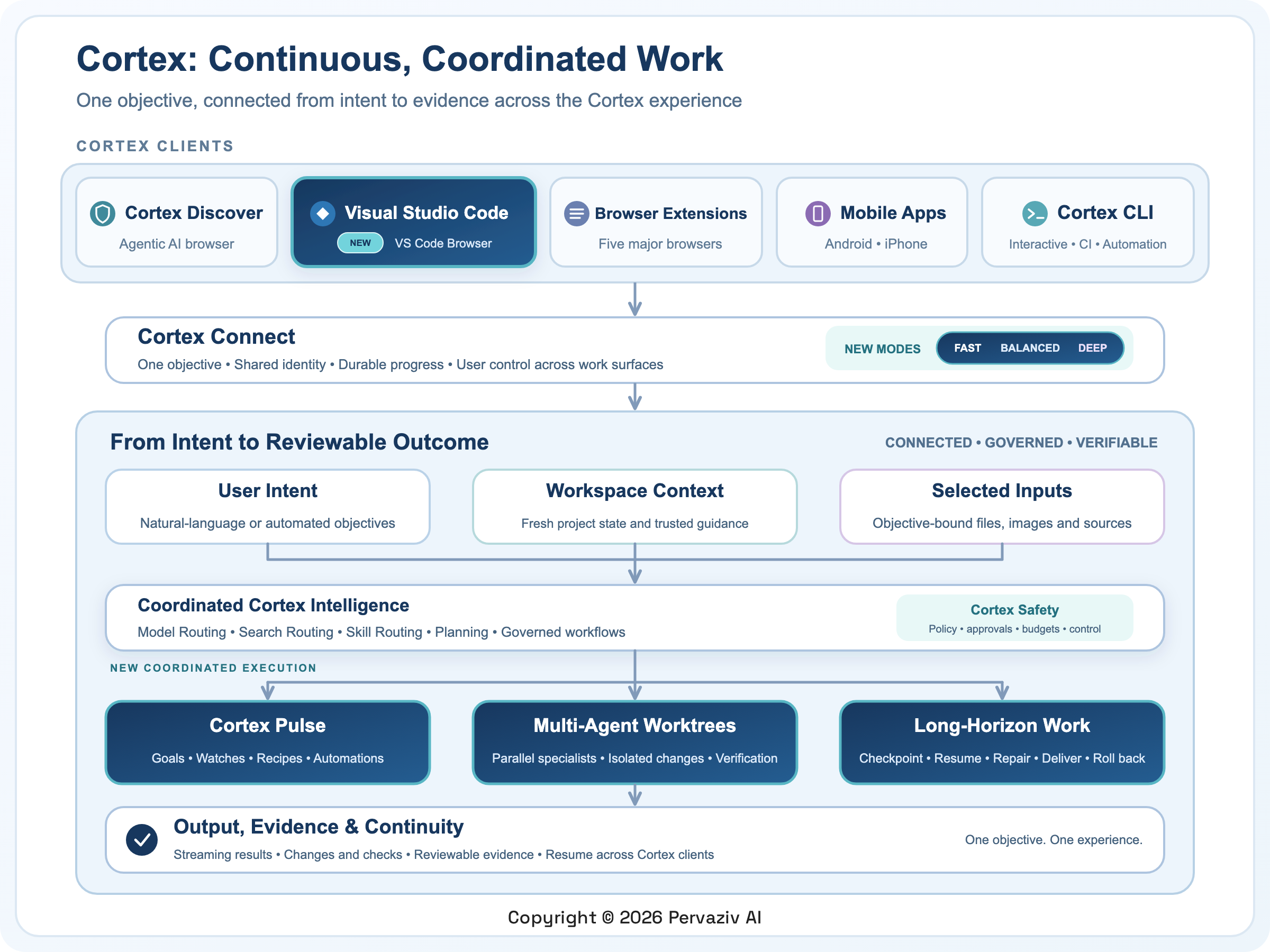
Cortex continuous coordinated work
Cortex Pulse, workflow automation, multi agent worktrees, long horizon execution and browser interaction create a more persistent Enterprise AI experience.
SAN FRANCISCO , CA, UNITED STATES, October 9, 2026 /EINPresswire.com/ -- Pervaziv AI today announced a major expansion of Cortex, moving its Enterprise AI platform from assistance centered on individual prompts toward continuous, coordinated work that can remain connected to an objective across time, tools, teams, and review points.
The latest Cortex capabilities introduce Cortex Pulse, Workflow Recipes and Automations, multi agent worktree orchestration, the Cortex VS Code Browser, long horizon work, and new Fast, Balanced, and Deep response modes. Together, they are designed to address a practical gap in Enterprise AI: useful work rarely begins and ends inside one conversation.
A software release may start with a question, expand into research, require changes across several areas of a repository, move through testing and security review, wait for a pull request or CI result, and return to a developer for a final decision. Business work can follow a similar pattern, beginning with a changing source or recurring briefing, moving into investigation and preparation, then waiting for an approval that arrives later.
Traditional AI experiences are strongest at the moment of interaction. A user asks, the system responds, and the session waits. Cortex is taking a broader approach. The platform is being designed to stay connected to the objective, understand relevant change, coordinate specialized effort, preserve progress through interruptions, operate in the right environment, and return with evidence that a person can review.
The direction builds on the architecture Pervaziv AI has been developing across Cortex Connect, Cortex Cloud, Cortex Discover, Cortex CLI, the Cortex AI Model Ensemble, Cortex Router, Cortex Planner, Collections, Chat Forks, and governed workflows. Rather than treating each capability as a separate assistant, Pervaziv AI is connecting them into a consistent product model for Enterprise AI.
## AI That Stays With the Work
------------------------------------------
The core idea behind the release is simple: Enterprise AI becomes more useful when it can remain connected to meaningful work for as long as the objective requires.
For enterprise teams, continuity must operate within clear boundaries. Cortex connects user intent, workspace context, and selected inputs with model routing, search routing, skill routing, planning, safety controls, and workflow logic, while keeping output, checks, evidence, and continuity tied to the original objective.
“Enterprise AI should stay with the work, not stop at the answer. Cortex keeps objectives moving across time, tools and teams, with people in control and evidence at every step,” said Anoop Jaishankar, Founder and CEO of Pervaziv AI.
## Cortex Pulse Brings Proactive AI Into Daily Work
--------------------------------------------------------------------
Many important tasks begin with a change rather than a prompt.
A build fails overnight. A pull request receives new feedback. A repository gets a new commit. A dependency publishes a security advisory. A project reaches a deadline. A scheduled report becomes available. By the time a user opens an AI assistant and asks what happened, part of the work has already been spent finding and prioritizing the right information.
Cortex Pulse is designed to change that rhythm.
Pulse can watch approved sources, identify relevant changes, prepare concise briefings, and surface opportunities, approvals, completions, failures, and next steps in a persistent experience organized around the user's goals. A focused Today view brings together what changed, what is in progress, what needs attention, and what has completed. The Cortex Inbox provides a durable place for briefing cards, questions, approvals, results, and failures.
For engineering teams, Pulse can follow approved repositories and surface commits, pull requests, CI activity, or conditions that need attention. In Visual Studio Code, repository related Pulse cards stay close to the project, while mobile can support briefings, approvals, pause, snooze, and emergency stop controls.
Pulse is designed around earned authority. Connecting a source provides visibility only within the approved scope. Watches define what Pulse should monitor. Rules define what it may prepare, propose, or perform. Budgets, quiet hours, notification policies, retention controls, and global pause controls keep proactive AI understandable and bounded.
## Workflow Recipes Turn Trusted Work Into Repeatable Capability
-----------------------------------------------------
Many workflows begin as one time requests and quickly become recurring patterns.
Teams repeatedly review release readiness, assess repository health, investigate incidents, compare changing sources, evaluate upgrades, or validate whether a process completed correctly. Rewriting the same prompt every time creates inconsistency. Traditional automation can reduce repetition, but it often requires separate builders, scripts, and maintenance that sit far from the people who understand the objective.
Workflow Recipes give Cortex a more natural path from successful work to repeatable work.
A recipe captures the useful structure behind reviewed work, including the decisions and evidence that made the result trustworthy. Teams can reuse that pattern, adapt it to another approved project, or connect it to a schedule through Cortex Automations.
Automations add the timing and execution layer. A user can select a project or source, define the task, establish a cadence and time zone, preview upcoming runs, select an execution environment, set budgets, and define how missed runs or failures should be handled. Manual run controls also allow scheduled work to be started when needed rather than only at the next planned time.
Pulse connects recurring work to its surrounding context. Scheduled runs can remain tied to the goal, source, evidence, status, and Inbox, so results arrive as part of the same Cortex experience rather than as isolated automation output.
## Multi Agent Worktrees Add Parallelism Without Losing Reviewability
----------------------------------------------------------
Complex engineering work often benefits from several specialized efforts happening at once.
One specialist may need to understand an unfamiliar part of a codebase. Another may prepare an implementation. A third may design tests. Another may review security implications or verify the combined result. Some steps depend on earlier findings, while others can proceed in parallel.
The challenge is not simply producing more output. It is coordinating the work without overlapping edits, hidden conflicts, or an unreviewable final state.
Cortex now combines multi agent orchestration with isolated Git worktrees. Each focused effort can develop and validate changes in a protected workspace without disrupting the developer's active environment. Cortex can coordinate the parts of a task that move forward together while preserving dependencies, boundaries, progress, and review points.
Agents contribute bounded work to a shared objective rather than simply producing several answers to the same prompt. Dependencies, permissions, and evidence connect each contribution to the combined result and keep the path to completion visible.
For a cross cutting product change, Cortex can coordinate investigation, implementation, testing, security review, and validation across separate streams, then bring the resulting work together for review. Conflicts and changing conditions remain visible rather than disappearing behind an automated combination of AI output.
## Browser Becomes a Development Surface Inside Visual Studio Code
---------------------------------------------------------------------
Modern software does not live only in source files. Developers move among code, repositories, pull requests, documentation, dashboards, security tools, consoles, and running applications. The browser is where much of that work is understood, coordinated, and completed.
The Cortex VS Code Browser brings that broader browser work directly into the development environment.
This direction was shaped by early design partners who asked for browser capabilities inside the developer tools they already use. Their feedback reinforced a practical point: developers gain more value when AI works naturally with established tools and workflows instead of forcing another disconnected surface.
Cortex can use the browser to research an issue, navigate code and repository context, review pull requests, follow build and test results, work with development dashboards, inspect a running application, and gather current evidence. With appropriate permissions and approvals, it can also help open or update a pull request, initiate supported checks or scans, and follow the result back into the development workflow.
That creates a more complete loop between understanding, action, and validation. A developer can begin with a pull request, an alert, a visible application issue, or a question about unfamiliar code. Cortex can connect what it finds in the browser with the repository and development tools in the same session, help move the work forward, and return with evidence relevant to the original objective.
The capability is especially valuable for work that crosses boundaries. A security finding may lead to code investigation and a prepared fix. A pull request may lead to a scan, review feedback, and further changes. A rendered issue may lead back to its source and then forward again to the updated application.
The browser is not merely where Cortex checks the answer. It becomes an active development surface where research, repository work, application interaction, supported actions, and validation can remain connected.
The Integrated Browser also connects current web evidence with the broader Cortex agent and connector experience. Approved pages can inform work across services and workspaces a team already uses. Existing permissions, safety controls, sharing policies, and approval requirements continue to govern external systems.
Cortex Discover remains the purpose built Agentic AI browser for broader enterprise web work. The VS Code Browser serves a complementary role by making browser powered development part of the workflow inside Visual Studio Code.
## Long Horizon Work Preserves the Objective Across Time
--------------------------------------------------------------
Some tasks take minutes. Others require an afternoon, an overnight run, several rounds of validation, or a later human approval.
Longer work introduces failure modes that short chat sessions can avoid. Connections drop. Processes restart. Dependencies change. A specialist fails after other work has completed. A validation step reveals that part of a plan needs repair. An approval arrives later. Replaying the entire workflow can waste useful progress or repeat a consequential action.
Cortex long horizon work is designed for those conditions.
A long running objective can remain connected to its progress, decisions, evidence, checkpoints, and current status across interruptions. Cortex can resume from a trusted point, preserve useful completed work, repair a failed portion when appropriate, and bring uncertain or consequential outcomes back to a person for review.
That continuity can carry an objective from discovery and planning through implementation, browser enabled development, validation, and delivery while preserving what was decided, completed, checked, or still needs approval.
This also strengthens the definition of completion. A task is not finished simply because an AI response says it is. Cortex can connect the final result with current evidence and make unfinished checks or decisions visible, giving teams a clearer basis for deciding whether the work is actually done.
Long horizon execution turns continuity into an operational capability. Teams can assign more meaningful objectives while retaining visibility into how the work is progressing, what has been verified, and where a person is still needed.
## Fast, Balanced, and Deep Put Reasoning Effort in the User's Hands
----------------------------------------------------------
Not every request should use the same level of reasoning.
A quick question should feel immediate. Everyday coding, research, and analysis often need a practical balance of speed and depth. A difficult investigation, architecture decision, or long running objective may justify more reasoning and broader context.
Cortex now provides three response modes: Fast, Balanced, and Deep.
Fast is designed for responsiveness on direct questions, concise transformations, quick explanations, and lightweight work. Balanced is the default middle ground for everyday Cortex use across coding, research, analysis, and workflow decisions. Deep gives complex tasks more room for reasoning and, where the user's plan and available capacity permit, can adapt to extended context for demanding investigations and larger objectives.
The selector is designed to remain consistent across Cortex experiences and travel with the session. Users choose the experience they want in simple product language rather than managing model providers, context window sizes, or other internal configuration. Cortex continues to coordinate the appropriate specialized intelligence underneath that preference.
For organizations, the modes also create a clearer relationship among urgency, depth, capacity, and cost. Enterprise policy can define what is available while employees retain an understandable choice for the work in front of them.
## One Connected Cortex Experience
--------------------------------------------------
The release also advances a more coherent interface for work that continues beyond a chat.
Collections keep related conversations organized. Chat Forks let users explore a different direction while preserving the original discussion. Pulse Today and Inbox bring proactive updates, approvals, and results into focused views. Schedules connect recurring work to the source, next run, recent outcome, and controls. Workflow status shows what is running, what has completed, and what needs attention. Browser artifacts and evidence connect work with current pages and rendered results. Repository cards keep project activity near the code. Pause, resume, run now, snooze, and emergency stop controls give users direct control over ongoing work.
A user can begin with a conversation, organize it into a Collection, explore another direction through a fork, turn the selected objective into a workflow, follow its progress, approve an important action, and receive a reviewed result through the same Cortex experience. A successful process can then become a reusable Workflow Recipe or scheduled Automation.
This release follows recent Cortex advances across several work surfaces. Cortex Discover expanded the browser into an agentic enterprise workspace. Cortex CLI brought the broader Cortex architecture into the terminal for interactive engineering and automation. Cortex Cloud added durable managed execution, while Cortex Connect established continuity across supported Cortex experiences.
The new capabilities extend that architecture over a longer span of work.
Teams can treat AI assisted work as a managed capability rather than isolated conversations. Processes can repeat. Parallel contributions can remain reviewable. Long running objectives can survive interruptions. Browser activity can become part of active development rather than a separate context. Routine monitoring can happen without constant manual checking. Human authority can remain visible where it matters.
Across the platform, Pervaziv AI continues to emphasize least privilege and reviewable outcomes. Sources are approved. Workspaces and worktrees are scoped. Rules define action authority. Schedules can operate within budgets and limits. Authenticated browser state requires explicit sharing. External changes remain tied to permissions and approvals. Completion is strengthened by evidence.
The broader message is a shift in what enterprise teams should expect from AI.
The quality of an answer still matters, but so do the moments around it: what caused the work to begin, how the objective was organized, which specialists contributed, where changes occurred, what happened after an interruption, how browser based work informed the result, and who approved consequential steps.
Cortex is bringing those moments into one connected product direction.
Pulse keeps changing work in view. Workflow Recipes and Automations turn trusted processes into repeatable capability. Multi agent worktrees coordinate specialized efforts with isolation and review. The VS Code Browser connects code, repositories, pull requests, development services, and running applications within the developer workflow. Long horizon work preserves progress and evidence across time. Fast, Balanced, and Deep let users match the experience to the task.
Together, the capabilities move Cortex from AI that helps in a moment toward an Enterprise AI Control Layer that can stay with the work, carry the objective through the environments where it belongs, and return with a result people can understand, review, and trust.
Pervaziv AI
Pervaziv AI
Visit us on social media:
LinkedIn
Instagram
YouTube
X
Other
Legal Disclaimer:
EIN Presswire provides this news content "as is" without warranty of any kind. We do not accept any responsibility or liability for the accuracy, content, images, videos, licenses, completeness, legality, or reliability of the information contained in this article. If you have any complaints or copyright issues related to this article, kindly contact the author above.
